

World Rivers Day 2026: What Forestrails Learned About Water While Making Clay Bottles
World Rivers Day 2026 falls on September 27. It is a day to stop and think about the rivers that give us water to drink,
Sustainable bottles are no longer just a trend they are a quiet revolution happening in Indian homes. Welcome to the Forestrails blog, where we explore the intersection of health, heritage, and the environment. Our story starts with one honest question: Why are we still drinking from plastic?
Every year, over 8 million tonnes of plastic enter our oceans and a significant portion of that comes from single-use plastic-free living alternatives that we haven’t yet adopted. In India alone, hundreds of millions of plastic-free water bottles are discarded annually.
We knew something had to change. And the answer, surprisingly, was right in our grandmothers’ kitchens all along.
Here’s what modern science confirms about clay bottle benefits:
This is why Forestrails was born to bring these benefits into modern, everyday life through thoughtfully crafted sustainable bottles.
The phrase “sustainable journey” can feel overwhelming. People imagine going fully off-grid, giving up conveniences, or spending a fortune on organic products. But eco-friendly living India-style has always been gentler than that. It begins with one mindful swap at a time.
Switching your water bottle is the lowest-barrier, highest-impact change you can make today. Here’s why:
Learn how clay compares to plastic in our detailed breakdown, and why the latter is losing the argument.
The concept of natural water storage aligns directly with what Charaka Samhita describes as “Sheetala” (cooling) and “Laghu” (light) properties of water qualities that modern refrigeration simply cannot replicate. Cold fridge water is inert; clay-cooled water carries an eco-friendly hydration effect that nourishes rather than shocks.
For a deeper dive into how water temperature affects your body, read our guide on Ayurvedic water temperature and why it matters.
This blog is for anyone who wants to live with a little more intention. Whether you’re curious about plastic-free living, exploring zero-waste lifestyle habits, or simply wondering whether your hydration choices are working for or against you you’re in the right place.
Here’s what to expect:
We’ll share practical, no-fuss steps that fit into a busy urban lifestyle from reducing plastic use and composting kitchen waste to making your home a little greener, one swap at a time. No extreme habits, just consistent choices.
Water stored in clay becomes naturally mildly alkaline. We’ll unpack what a 2017 PMC clinical study comparing alkaline water and Mediterranean diet for reflux actually says no pseudoscience, just honest, evidence-backed information on how your water choice affects digestion, energy, and well-being.
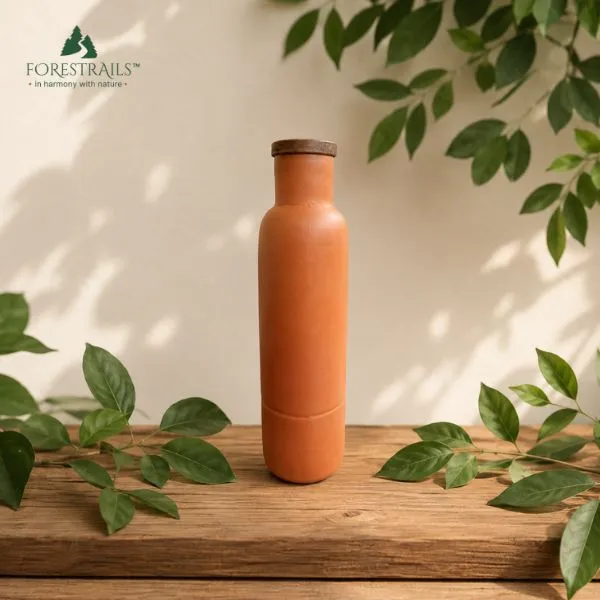
Yes. Unglazed, food-grade terracotta clay bottles like those made by Forestrails are completely safe. They contain no chemical coatings, no BPA, and no synthetic liners. The clay itself has been used for water storage across Indian households for thousands of years.
A clay bottle naturally cools water, adds trace minerals, and maintains a mild alkaline pH none of which plastic can do. More importantly, it doesn’t leach harmful chemicals the way plastic does, especially under heat. See ourfull clay vs. plastic comparison here.
It starts with small, tangible swaps replacing your plastic bottle with a clay one, refusing single-use cups, and being more intentional about what you consume. Over time, these micro-decisions compound into a genuinely plastic-free living lifestyle.
In the short term, a quality clay bottle costs more than a single plastic one. But over a year replacing hundreds of plastic bottles it’s dramatically cheaper, healthier, and leaves zero plastic behind.
World Rivers Day 2026 falls on September 27. It is a day to stop and think about the rivers that give us water to drink,

Traditional clay products are useful in modern homes because they cook food slowly, keep water and grain cool without power, and break down into soil when you are