
World Rivers Day 2026: What Forestrails Learned About Water While Making Clay Bottles
World Rivers Day 2026 falls on September 27. It is a day to stop and think about the rivers that give us water to drink,

Picking eco friendly materials for your home is not a one-size-fits-all job. Bamboo, jute, wood, glass, and clay bottles each do something well and something poorly. The material that suits your kitchen might fail in your bathroom. This guide walks through all five, plain and simple, so you can match the material to the actual job.

True eco friendly materials earn the label on three counts: how they’re made, how long they last, and what happens when you throw them away. A plastic bottle might be cheap and light, but it sits in a landfill for centuries. A clay bottle costs more upfront but goes back into the earth without leaving a trace. That trade-off runs through every material on this list.
Bamboo is grass, not wood, and it grows fast. Some species shoot up close to a meter a day and store far more carbon per hectare than a typical forest, around 17 tons of CO2 per hectare each year, about four times that of tropical rainforests (peer-reviewed bamboo materials review). That fast regrowth is bamboo’s biggest selling point.
Where bamboo struggles is water and humidity. Untreated bamboo furniture can warp, crack, or invite mold in a damp kitchen or bathroom. It also needs a food-safe sealant for cutting boards and utensils, or it absorbs odors and stains over time.
Jute products are everywhere in Indian homes: shopping bags, rugs, wall hangings, packaging. India grows most of the world’s jute, accounting for roughly 75% of estimated world production (Jute production in India, Wikipedia), so it’s a genuinely local material to shop for.
Jute rots fast in water, so skip it for anything that gets wet often. It’s also rougher than cotton, so it’s not the best pick for anything touching skin for long. But for bags, mats, and packaging, it does the job and breaks down completely when you’re done with it.
Solid wood furniture can last decades with care, and that long life is what makes it sustainable. But wood is only as eco-friendly as the forest it came from. Look for the FSC certification mark, which confirms the timber came from a forest that’s managed responsibly and gets replanted, not clear-cut.
This is where bamboo vs wood comes down to patience versus permanence. Bamboo regrows in a few years; a hardwood tree takes decades. Wood, once built into furniture, can outlast several generations of bamboo pieces if you look after it.
Glass sustainable products have one advantage nothing else on this list can match: glass can be melted down and remade over and over with no drop in quality, and in the US alone, over 3 million tons of glass containers get recycled each year (EPA glass material data). It’s also completely inert, so it won’t leach anything into your food or drink, hot or cold.
The catch is weight and breakage. Glass is heavy to ship, and one drop on a tile floor means cleaning up shards. It’s a great pick for storage jars and drinkware at home, less practical for anything that travels with you daily.

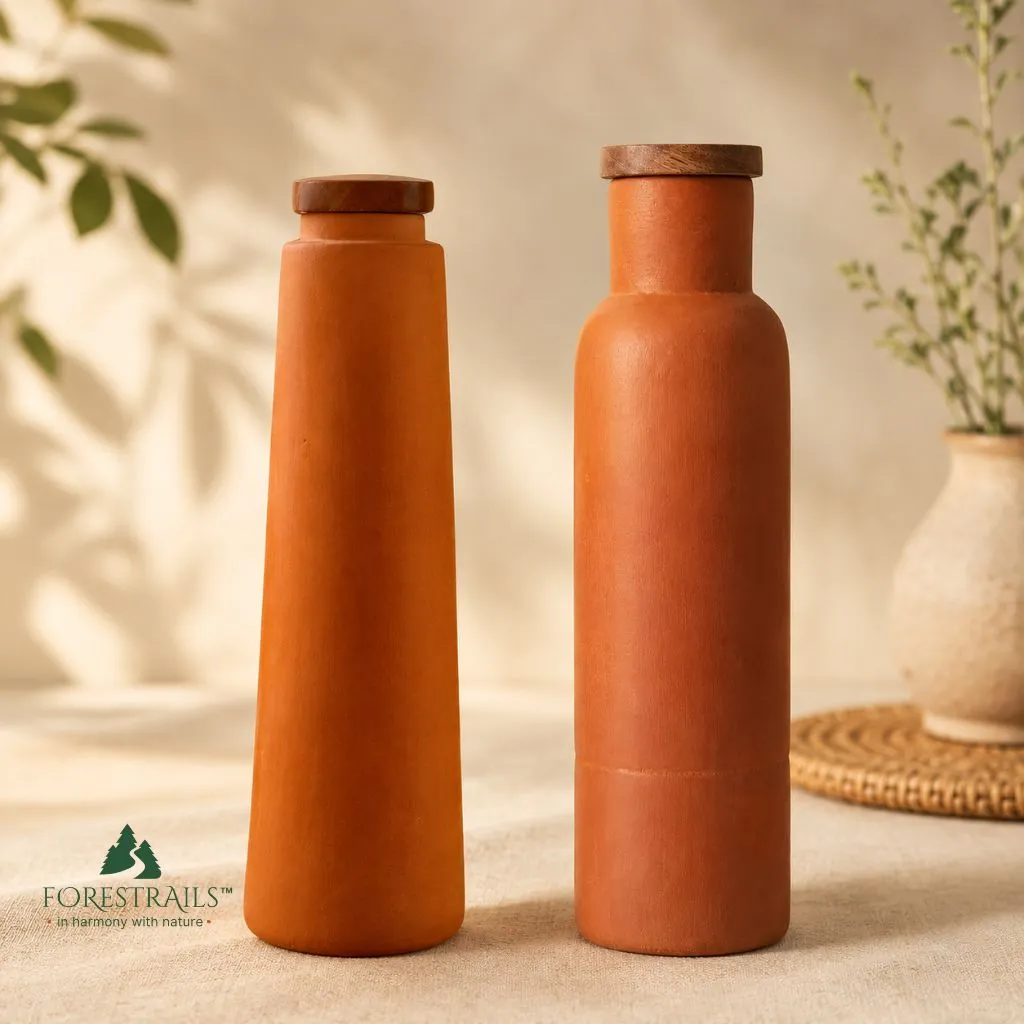
Clay bottles and terracotta pots have been used for water storage in India for thousands of years, and the science backs up why. Clay is porous, so water seeps very slowly through the walls and evaporates on the outside surface, cooling what’s left inside without electricity. A recent lab study on clay pots found water stored in them for a week met drinking water quality standards, and the clay’s natural filtering even reduced total bacteria and Legionella counts (peer-reviewed clay pot water quality study).
Clay does have limits. It’s breakable if dropped, and it needs a gentle wash rather than a scrub with harsh soap, since the porous surface can hold onto strong smells. If you want the full how-to, we’ve written a dedicated guide on how to clean and maintain your clay water bottle and another comparing clay bottles vs RO-purified water if you’re weighing your options for daily hydration.
For anyone building a full sustainable home materials checklist, clay covers the hydration and cookware corner in a way nothing plastic or metal really matches, since it’s fired earth with nothing synthetic added. It’s also fully biodegradable at the end of its life, unlike ceramics with heavy glazes.
If you’re curious why Ayurveda leans on clay so heavily for water storage, our piece on Ayurvedic water wisdom and traditional hydration goes deeper into the reasoning, and our 5 reasons to choose a clay water bottle post breaks down the everyday benefits one by one.
| Material | Durability | Maintenance | Typical Lifespan | Best Use Case |
| Bamboo | High (dry use) | Oil regularly | 3-8 years | Furniture, cutting boards |
| Jute | Moderate | Spot clean, air dry | 1-3 years | Bags, packaging, rugs |
| Wood | Very high | Polish occasionally | 20+ years | Furniture, flooring |
| Glass | High (fragile) | Wash and dry | Indefinite | Storage, drinkware |
| Clay / Terracotta | Moderate | Rinse, no soap | 5-10 years | Water storage, cooking pots |
There’s no single winner, and any list that says otherwise is selling something. If you travel a lot, glass and clay ask for the most care. If your home is dry, bamboo and jute hold up fine. If you’re furnishing for the long term, certified wood pays for itself over 15 to 20 years. And if daily hydration matters to you, a well-made clay bottle does something plastic and steel can’t: it keeps water cool and mineral-rich the way it has for generations, with no synthetic layer touching your water.
The honest approach with eco friendly materials is to mix them by room: wood in the living room, glass in the pantry, jute for grocery runs, bamboo in the kitchen, clay by your bedside. Read more on pairing sustainable home materials this way in our eco-friendly kitchen swaps guide.
If you’re starting your switch to eco friendly materials with something you use every single day, water is a good place to begin. Forestrails makes handmade clay bottles the traditional way, using natural terracotta clay and no synthetic linings. Have a look at the range when you’re ready.
Bamboo regrows much faster than trees, so it’s the better pick for short-term or replaceable items. Wood wins on long-term furniture since it can last 20 years or more when it’s certified and well cared for.
Yes. Clay is porous, so a thin layer of water seeps through the walls and evaporates on the surface, which pulls heat out and cools the water inside, without any electricity.
Jute weakens quickly when it’s wet and can start to smell if it stays damp. Wipe spills right away and let jute bags or mats dry fully before you store them.
Glass can be recycled over and over with no loss in quality, while plastic degrades in quality each time it’s recycled and eventually ends up as landfill or microplastic. Glass is heavier to ship, but it lasts far longer.
With careful daily use, a good clay water bottle lasts 5 to 10 years. Avoid dropping it on hard floors and skip the dishwasher, since a simple rinse with warm water is all it needs.
Jute is usually the least expensive entry point, since bags and packaging cost very little. Clay bottles and bamboo kitchenware sit in the middle price range, and solid certified wood furniture costs the most upfront.
World Rivers Day 2026 falls on September 27. It is a day to stop and think about the rivers that give us water to drink,

Traditional clay products are useful in modern homes because they cook food slowly, keep water and grain cool without power, and break down into soil when you are