
World Rivers Day 2026: What Forestrails Learned About Water While Making Clay Bottles
World Rivers Day 2026 falls on September 27. It is a day to stop and think about the rivers that give us water to drink,

Tree plantation drives can be found across schools, offices and communities in every July. Van Mahotsav 2026 is much more than just a symbolic custom though many regard them as yearly events. It coincides with the monsoon for better survival of saplings and is indicative of India’s long-standing commitment to protect and expand its green cover. Knowing this, planting a tree is a meaningful step towards a healthier, more sustainable future.
Van Mahotsav 2026 is India’s annual “festival of trees,” observed from July 1st to July 7th. It was formally launched in 1950 by K.M. Munshi, then India’s Union Minister for Agriculture and Food, though the idea traces back even further to a 1947 tree-planting week organized in Delhi. The importance of tree plantation in India was obvious even then a newly independent country, facing deforestation and soil erosion, needed a public movement, not just a policy file.
What makes the date deliberate rather than symbolic is the monsoon. The southwest monsoon typically arrives in the first week of July, and freshly planted saplings need that rainfall to establish roots. Plant a sapling in April’s heat and it likely won’t survive the summer. Plant it during Van Mahotsav week, and the odds shift dramatically in its favor. That’s why is Van Mahotsav celebrated exactly when it is it’s an agronomic decision dressed up as a festival.
It’s tempting to think tree planting is a rural or forest-department concern. It isn’t. Cities are where the loss is felt most acutely. Concrete, asphalt, and glass absorb and re-radiate heat, creating what scientists call the urban heat island effect a phenomenon where a city can run several degrees hotter than the countryside around it. Research tracking India’s most populated cities found built-up areas expanding by close to half in city cores over just fifteen years, with tree cover shrinking in step.
Tree canopy is one of the few interventions that directly counters this. Shaded streets measure noticeably cooler than open, treeless ones, thanks to a combination of shade and evapotranspiration the natural cooling effect of moisture releasing from leaves. Beyond temperature, urban trees filter airborne particulate matter, support pollinators and birds in habitats that would otherwise be fragmented concrete, and as a growing body of research shows quietly support mental well-being.
A well-known review of greenspace and mental health studies found that people living in neighborhoods with more accessible greenery consistently report lower anxiety, lower distress, and better overall wellbeing than those without it. That’s the real answer to why is tree plantation important for urban areas in India it isn’t decorative, it’s protective infrastructure.

It’s easy to feel like one sapling can’t possibly matter against the scale of a warming planet. But tree plantation importance isn’t measured tree-by-tree it’s measured in what one tree quietly does, every single day, for decades. A mature tree pulls carbon dioxide out of the air and locks it into wood and roots. Its canopy intercepts rainfall, slowing runoff and letting water soak into the ground instead of flooding storm drains. Its roots hold soil in place. Its shade can lower the surface temperature of the pavement beneath it by several degrees.
Trees also do something less discussed: they filter the air we breathe. Certain Indian species peepal, neem, and mango among them have been found in research on pollution-tolerant species to be particularly effective at absorbing and filtering airborne pollutants in high-pollution zones. Urban green cover, more broadly, has been linked in air quality studies to meaningful reductions in ambient particulate matter. One tree won’t fix a city’s air. A million of them, planted consistently over decades, changes what an entire generation breathes.
Here’s the honest bridge: planting a tree once a year is meaningful, but it isn’t the whole picture. Sustainable living India is really a collection of small, repeated choices how much plastic passes through your kitchen, how much water you waste, what you replace instead of throw away. Van Mahotsav’s spirit doesn’t have to end on July 7th. The same values it represents restoring rather than depleting, choosing natural over disposable are things you can practice every week of the year, not just during a designated one.
You don’t need a farm or a forest department ID to participate in eco-friendly lifestyle tips. Some of the most effective changes are things already sitting in your home, waiting to be used differently:
Carry a cloth or jute bag instead of accepting a plastic one at the store. Switch to a steel or reusable lunch box instead of cling-film-wrapped disposables. Start a small compost bin for kitchen scraps even a balcony-sized one diverts real weight from landfill. Choose natural materials like clay, bamboo, or cotton over single-use plastic wherever there’s a reasonable substitute. None of these require a lifestyle overhaul. They require noticing, once, that a disposable habit has a reusable alternative and then sticking with it.
If you’re the kind of person who’s already aware of plastic pollution but stuck on where to actually start, begin with what touches your hands daily. Your drinking water routine is a good place to look first it’s one of the few habits repeated multiple times, every single day, for the rest of your life. Traditional materials like natural clay have been used for water storage in India for generationslong before single-use plastic bottles existed, precisely because they required no factory, no petroleum, and no waste stream at the end of their life.
The broader principle matters more than any single product: every time you choose something reusable over something disposable, you’re voting in a very literal, repeated way for less landfill, less plastic runoff, and fewer resources extracted to replace what you just threw away.
If you want to genuinely mark Van Mahotsav 2026 this year, here are ways to do it that go beyond a single afternoon with a sapling:
Plant a native tree in a spot where you can realistically water it for the next two years survival matters more than the planting photo. Gift a sapling to a neighbour or coworker instead of a disposable gift. Join or organize a community cleanup in a local park. Support a local nursery or artisan instead of a mass-manufactured import. Start composting if you haven’t already. Cut down on single-use plastics in your kitchen and bathroom, one category at a time. Each of these extends the same intention Van Mahotsav was built on restoring rather than depleting into the other 358 days of the year.
Native species survive better than imported ornamentals because they’re already adapted to local rainfall, soil, and pest patterns. If you’re planting this year, consider native trees to plant in India such as Neem, Banyan, Peepal, Jamun, Indian Gooseberry (Amla), and Arjuna. Researchers studying urban cooling strategies specifically point to dense-canopy, drought-tolerant species like these as the best choices for maximizing shade and long-term survival in Indian city conditions. Beyond hardiness, native trees also better support local birds and insects that co-evolved with them an imported ornamental might look nice, but it often feeds no one.

Individual action matters, but Van Mahotsav has always been designed as a collective movement. Schools run plantation drives that double as environmental education. Apartment societies use the week to green shared compounds and courtyards. Companies run CSR-linked plantation events, sometimes pairing them with employee volunteering days. If your workplace or society hasn’t organized anything yet, this is a low-effort, high-goodwill initiative to suggest most municipal bodies and civic nurseries supply saplings free of cost during this week specifically to encourage exactly this kind of participation.
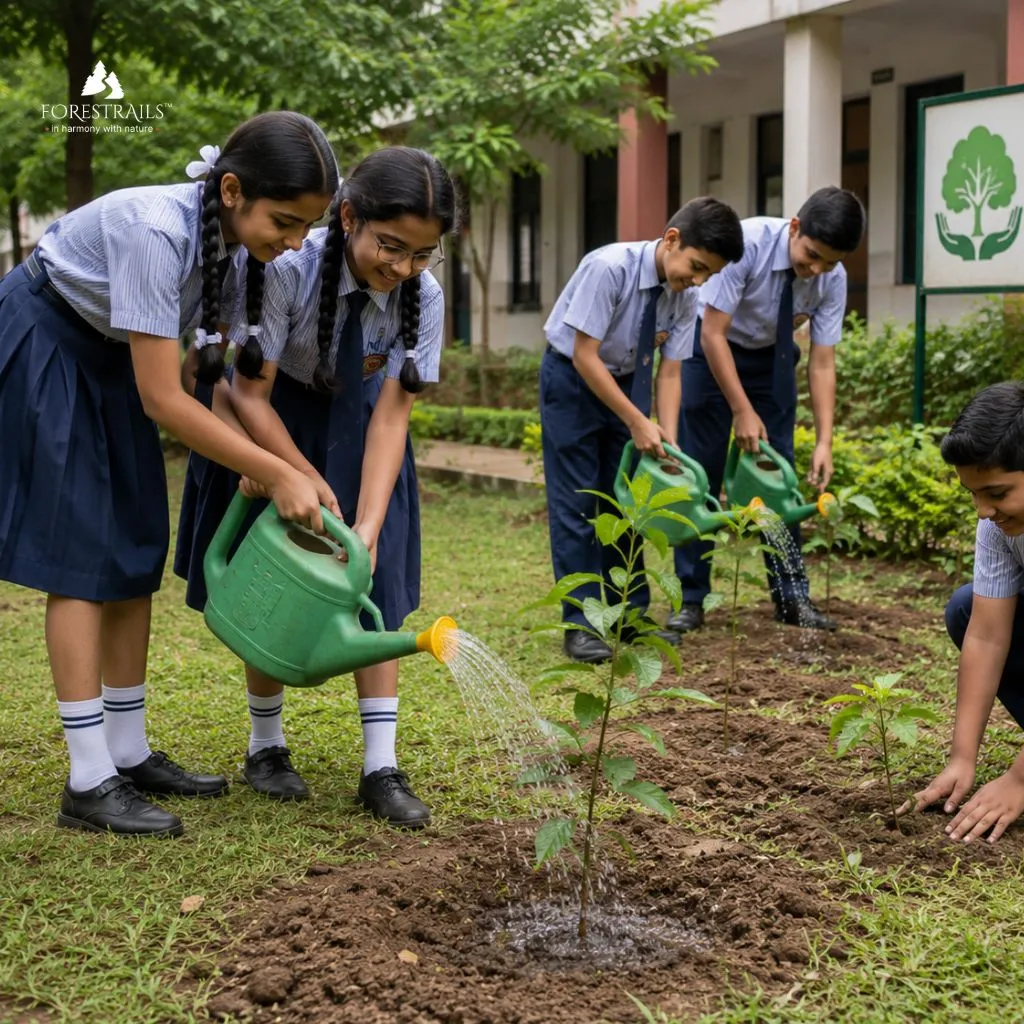
Planting a tree is one of the most direct, physical actions you can take for the environment you can literally watch it grow. But tree plantation in India works best as part of a bigger pattern, not a once-a-year gesture. Reducing plastic use, supporting local artisans and nurseries, composting, and choosing reusable, natural materials over disposable ones all pull in the same direction. None of it needs to be perfect. It needs to be consistent.
If you’re already looking at your daily habits with fresh eyes this Van Mahotsav, your drinking water routine is worth a second look too. Forestrails’ handcrafted clay water bottles are one small, practical way to carry the same values natural materials, artisan-made, no plastic into something you use every single day.
It was launched in 1950 to encourage mass tree planting after independence-era deforestation, and it’s timed to the monsoon so saplings get the rainfall they need to survive.
Urban trees cool concrete-heavy neighbour hoods, filter airborne particulate matter, support biodiversity, and are linked to measurable improvements in residents’ mental well-being.
Trees absorb carbon dioxide, reduce surface and air temperature, slow rainwater runoff, prevent soil erosion, and create habitat for birds and insects.
Leaves and bark trap particulate matter and absorb certain gaseous pollutants directly from the air, and dense urban tree cover has been linked to measurable drops in ambient pollution levels.
Neem, Banyan, Peepal, Jamun, Indian Gooseberry, and Arjuna are commonly recommended for their adaptability, shade, and survival rates in Indian conditions.
Plant a native tree you can actually water long-term, gift a sapling, join a local cleanup, cut back on single-use plastic, and support local artisans and nurseries.
Natural and reusable materials avoid the manufacturing footprint and landfill waste of single-use plastic, and many like clay have been used sustainably in India for generations.
World Rivers Day 2026 falls on September 27. It is a day to stop and think about the rivers that give us water to drink,

Traditional clay products are useful in modern homes because they cook food slowly, keep water and grain cool without power, and break down into soil when you are